Nexus Repository Manager Rootfs: Artifact Server Image Build and Integration for the Iximiuz Labs
Context
Nexus Repository Manager Rootfs is a production-grade Nexus 3 Community Edition image for iximiuz playgrounds. It runs on top of ubuntu-24-04-rootfs, booting lab-init → nginx → nexus via systemd, with Nginx on port 80 and cloudflared pre-installed for Cloudflare Tunnel custom-domain access.
The image uses its own embedded storage under /opt/sonatype-work: no external database is required.
MicroVM Rootfs
This image is a microVM rootfs for the iximiuz Labs platform. The platform mounts it as a block device and boots it with its own kernel. systemd becomes PID 1 through the platform boot process. Do not attempt to validate systemd, service behavior, or Nexus startup via docker run: use labctl instead (see Verification).
Quick Start
Skip the build and try it now: Launch Nexus Playground↗. Click Start, and Nexus boots behind Nginx in the browser in under two minutes. The rest of this page covers how the image itself is built.
All source artifacts:
| Artifact | Path |
|---|---|
| Dockerfile | iximiuz/rootfs/nexus/Dockerfile |
| Scripts | iximiuz/rootfs/nexus/scripts/ |
| Configs | iximiuz/rootfs/nexus/configs/ |
| Welcome banner | iximiuz/rootfs/nexus/welcome |
| CI Workflow | .github/workflows/build-nexus-rootfs.yml |
| iximiuz Manifest | iximiuz/manifests/nexus-server.yml |
Objectives
Nexus Rootfs must:
- Provide Nexus 3.89.1-02 CE running as the
nexussystem user on top ofubuntu-24-04-rootfs. - Boot in the sequence
lab-init→nginx→nexusvia systemd, exposing Nexus through Nginx on port 80 immediately on first boot. - Configure Nginx as a reverse proxy using build-time port substitution (
__NEXUS_PORT__), with a/healthendpoint. - Write Nexus port and host into
nexus.propertiesat build time; no manual configuration needed after first boot. - Provide
cloudflaredfor instant public domain exposure without firewall rules. - Apply a limited
sudoprofile for thenexusdaemon user: service management and log inspection only. - Be built reproducibly via GitHub Actions and published as
ghcr.io/ibtisam-iq/nexus-rootfswithlatest,community, and3.89.1.02-communitytags.
Architecture / Conceptual Overview
The image inherits the full OS base from ubuntu-24-04-rootfs (systemd, SSH, non-root user ibtisam, shell config, base tools) and adds a Nexus runtime stack on top:
| Layer | Components |
|---|---|
| Inherited from base | systemd, SSH, user ibtisam, bash config, base tools |
| Runtime stack | Java 21 (OpenJDK), Nexus CE 3.89.1 (nexus user), Nginx reverse proxy, cloudflared |
| Systemd units | lab-init.service, nginx.service (override), nexus.service |
| Security | Limited sudoers for nexus daemon, no full root |
Boot Sequence
systemd (PID 1)
  └── lab-init.service  [oneshot]
        Generates SSH host keys (ephemeral per VM)
        Creates /run/sshd, /run/nginx
        Fixes /opt/nexus and /opt/sonatype-work ownership
        Creates /opt/sonatype-work/jvm-prefs (JVM user prefs)
          ↓ (Before= constraint respected by systemd)
  └── nginx.service     [simple, daemon off]
        Listens on :80
        Reverse proxies → 127.0.0.1:NEXUS_PORT
          ↓
  └── nexus.service     [simple]
        /opt/nexus/bin/nexus run
        Runs as nexus:nexus
        OOMScoreAdjust=-900 (protected from OOM killer)
        LimitNOFILE=65536, LimitNPROC=8192
Port and Config Substitution
__NEXUS_PORT__ is a build-time placeholder substituted via sed during the Docker build in:
| File | What changes |
|---|---|
/etc/nginx/sites-available/nexus | upstream nexus { server 127.0.0.1:__NEXUS_PORT__ } |
$HOME/.welcome | Displayed URL in the welcome banner |
Additionally, install-nexus.sh writes nexus.properties directly with the port value:
This means Nexus is fully configured at build time; no manual port configuration needed at runtime.
Key Decisions
Nexus is architecture-aware: install-nexus.sh detects the CPU architecture and builds the correct Sonatype download URL. Sonatype uses linux-aarch_64 (with underscore) for ARM, not aarch64; the script handles this explicitly. The CI workflow builds linux/amd64 only (QEMU intentionally omitted).
JVM user prefs directory: The nexus system user has no home directory (--no-create-home). Without intervention, the JVM attempts to write user preferences to ~/.java and fails silently. install-nexus.sh appends -Djava.util.prefs.userRoot=/opt/sonatype-work/jvm-prefs to nexus.vmoptions. lab-init.sh recreates this directory at every boot and ensures nexus:nexus ownership, because /opt/sonatype-work permissions may be reset when the microVM mounts it fresh.
lab-init.service runs before SSH, Nginx, and Nexus: SSH host keys are deleted from the base image (unique per VM; lab-init.sh regenerates them via ssh-keygen -A at each boot). /run/sshd and /run/nginx are wiped by tmpfs on every reboot. /opt/nexus and /opt/sonatype-work ownership must be confirmed as nexus:nexus at every boot. Without this, all three services would fail to start.
Nginx as canonical entry point: All external traffic enters via Nginx on port 80. Nexus only listens on 0.0.0.0:NEXUS_PORT internally. client_max_body_size 1G is set in nginx.conf to support large artifact uploads (Maven JARs, Docker layers). Nexus does not have its own reverse-proxy awareness headers in this configuration; the proxy headers (X-Real-IP, X-Forwarded-For, X-Forwarded-Proto) are set at the Nginx layer.
Limited sudo for nexus daemon: configs/sudoers.d/nexus-user grants the nexus system user passwordless access to: systemctl restart/stop/start/status nexus, systemctl reload nginx, and journalctl. No full root. This limits blast radius if Nexus is compromised.
USER root at image end + CMD ["/lib/systemd/systemd"]: Nexus rootfs ends as USER root. This is required because CMD ["/lib/systemd/systemd"] must start as root. When the iximiuz platform boots the microVM, it runs as root regardless; the explicit USER root + CMD makes the intent unambiguous and allows docker run to attempt systemd boot (which will fail in a plain container as expected).
BUILD_DATE and VCS_REF are not passed as build-args in CI: The workflow does not pass BUILD_DATE or VCS_REF as explicit build-args. The Dockerfile LABEL block interpolates these from the ARGs, so the org.opencontainers.image.created and org.opencontainers.image.revision OCI labels will be empty strings. The docker/metadata-action step does inject these into image labels via its own mechanism, but only at the OCI manifest layer, not via ARG substitution in the LABEL block. This is a known gap.
Source Layout
nexus/
├── Dockerfile
├── README.md
├── welcome
├── configs/
│   ├── nginx.conf                      # client_max_body_size 1G; upstream on __NEXUS_PORT__
│   ├── nexus.service                   # Type=simple; /opt/nexus/bin/nexus run as nexus:nexus
│   ├── sudoers.d/
│   │   └── nexus-user                  # Limited sudo: service control + journalctl only
│   └── systemd/
│       └── lab-init.service            # oneshot: Before=ssh,nginx,nexus
└── scripts/
    ├── install-nexus.sh                # Java 21 + Nexus CE 3.89.1 (arch-aware download)
    ├── configure-nginx.sh              # Installs nginx, enables site, systemd override
    ├── lab-init.sh                     # SSH keys + /run dirs + nexus data perms at each boot
    ├── healthcheck.sh                  # Build-time validation (8 sections)
    ├── customize-bashrc.sh             # Nexus/Nginx aliases → ~/.bashrc
    └── install-cloudflared.sh          # Cloudflare Tunnel CLI
Build Arguments
| ARG | CI Default | Description |
|---|---|---|
USER | ibtisam | Interactive non-root user (inherited from base) |
NEXUS_PORT | 8081 | Nexus HTTP port (substituted in nginx, nexus.properties, welcome) |
BUILD_DATE | From CI metadata-action | OCI label: image creation timestamp |
VCS_REF | github.sha | OCI label: git commit SHA |
Prerequisites
ghcr.io/ibtisam-iq/ubuntu-24-04-rootfs:latestbuilt and published (theFROMreference).- Local checkout of
github.com/ibtisam-iq/silver-stackwithiximiuz/rootfs/nexus/available. - Docker Buildx available locally, or a GitHub Actions runner with
docker/setup-buildx-action. - Network access to
download.sonatype.com(Nexus binary), apt (Java, Nginx, cloudflared). - For CI:
packages: writepermission to push to GHCR viasecrets.GITHUB_TOKEN.
Build Steps
1. Local Build
From iximiuz/rootfs/nexus/:
docker build \
  --build-arg USER="ibtisam" \
  --build-arg NEXUS_PORT=8081 \
  -t ghcr.io/ibtisam-iq/nexus-rootfs:latest \
  .
Note
BUILD_DATE and VCS_REF are injected by CI. Local builds do not require them.
The Dockerfile performs the following sequence in order:
Step 1: Inherit the base
FROM ghcr.io/ibtisam-iq/ubuntu-24-04-rootfs:latestUSER rootfor all installation steps- ARGs declared:
USER,NEXUS_PORT,BUILD_DATE,VCS_REF ENVsets:NEXUS_HOME=/opt/nexus,NEXUS_DATA=/opt/sonatype-work,NEXUS_PORT,JAVA_HOME,PATH(Java bin prepended),TZ=UTC
Step 2: Copy and parameterize configs
COPY configs/nginx.conf /etc/nginx/sites-available/nexus→sedreplaces__NEXUS_PORT__COPY configs/nexus.service /etc/systemd/system/nexus.serviceCOPY configs/sudoers.d/nexus-user /etc/sudoers.d/nexus-userCOPY configs/systemd/lab-init.service /etc/systemd/system/lab-init.service
Note
Dockerfile does not run sed on nexus.service for port substitution. The port is written directly into nexus.properties by install-nexus.sh at the next step.
Step 3: Copy build-time scripts
COPY scripts/ /opt/nexus-scripts/+chmod +x *.sh
Step 4: Install Java 21 + Nexus CE (install-nexus.sh ${NEXUS_PORT})
- Validates port argument.
- Installs
openjdk-21-jdkvia apt. - Detects CPU arch (
x86_64→linux-x86_64,aarch64→linux-aarch_64). - Downloads
nexus-3.89.1-02-linux-<arch>.tar.gzfrom Sonatype CDN. - Extracts to
/opt/nexus, removes tarball. - Creates
nexussystem user (--system --no-create-home --shell /bin/bash). - Sets ownership:
chown -R nexus:nexus /opt/nexus /opt/sonatype-work, permissions750. - Writes
run_as_user="nexus"to/opt/nexus/bin/nexus.rc. - Writes
nexus.propertieswithapplication-port,application-host=0.0.0.0,nexus-context-path=/. - Appends
-Djava.util.prefs.userRoot=/opt/sonatype-work/jvm-prefstonexus.vmoptions. - Creates
/opt/sonatype-work/jvm-prefsand setsnexus:nexusownership.
Step 5: Configure Nginx (configure-nginx.sh)
- Installs
nginxvia apt. - Validates
/etc/nginx/sites-available/nexusexists (COPY'd in Step 2). - Removes default Nginx site, enables Nexus site symlink.
-
Creates systemd override
/etc/systemd/system/nginx.service.d/override.conf:Type=simple,ExecStart=/usr/sbin/nginx -g 'daemon off;'- Required for systemd container compatibility.
- Runs
nginx -tto validate config.
Step 6: Enable systemd units
Creates symlinks in/etc/systemd/system/multi-user.target.wants/. Validated by healthcheck.sh. Step 7: Build-time healthcheck (healthcheck.sh ${USER})
Validates 8 sections without starting services (systemd not running during build):
| Section | What is checked |
|---|---|
| 1. System tools | curl, wget, git, vim, nginx present |
| 2. Java | java, javac commands; JAVA_HOME set |
| 3. Nexus installation | /opt/nexus/bin/nexus present; nexus.rc has run_as_user="nexus"; /opt/nexus owned by nexus |
| 4. Nexus port config | nexus.properties exists; application-port=NEXUS_PORT; nginx upstream port matches |
| 5. Nginx config | Site file present; symlink enabled; default removed; nginx -t passes |
| 6. Systemd units | lab-init, ssh, nginx, nexus symlinks in multi-user.target.wants/ |
| 7. SSH config | sshd_config and sshd binary present; host keys absent (expected: generated at boot) |
| 8. Users | Interactive $USER account; sudoers.d/nexus-user present |
Step 8: Install cloudflared (install-cloudflared.sh)
- Adds Cloudflare apt repository and GPG key.
- Installs
cloudflared.
Step 9: Fix ownership
chown -R ${USER}:${USER} /home/${USER}
Step 10: User customizations
USER $USER+ENV HOME=/home/$USERCOPY welcome $HOME/.welcome→sed -ireplaces__NEXUS_PORT__-
customize-bashrc.sh(bind mount) appends to~/.bashrc:nexus-status,nexus-logs,nexus-restart,nexus-start,nexus-stopnginx-status,nginx-logs,nginx-reload- Standard
ll,la,laliases
Step 11: Return to root + CMD
USER root: required forCMD ["/lib/systemd/systemd"]EXPOSE 22 80 ${NEXUS_PORT}CMD ["/lib/systemd/systemd"]
2. Build and Push via GitHub Actions
Canonical build: .github/workflows/build-nexus-rootfs.yml
Triggers:
pushtomainwhen files underiximiuz/rootfs/nexus/**(excludingREADME.md) or the workflow file change.- Pull requests with the same path filters.
- Manual
workflow_dispatch.
Key steps:
- Checkout repository.
- Set up Docker Buildx (no QEMU: amd64 only, intentional).
- Log in to GHCR via
secrets.GITHUB_TOKEN. - Extract metadata via
docker/metadata-action:- Tags:
latest,community,3.89.1.02-community(on default branch),sha-<short>,YYYY-MM-DD - Labels include
org.opencontainers.image.base.name=ghcr.io/ibtisam-iq/ubuntu-24-04-rootfs:latest
- Tags:
docker/build-push-actionwith:context: ./iximiuz/rootfs/nexusplatforms: linux/amd64push: true(non-PR only)build-args: USER=ibtisam,NEXUS_PORT=8081- GHA layer cache enabled.
- Print final image digest.
Known gap
BUILD_DATE and VCS_REF are not passed as explicit build-args. The Dockerfile LABEL block will produce empty string OCI labels for created and revision. The docker/metadata-action does inject these into the OCI manifest labels at the image layer, but not via Dockerfile ARG interpolation.
Verification
✅ Correct: Inspect the Registry Image
skopeo inspect docker://ghcr.io/ibtisam-iq/nexus-rootfs:latest \
  | jq '{
      name: .Name,
      base: .Labels["org.opencontainers.image.base.name"],
      created: .Labels["org.opencontainers.image.created"],
      documentation: .Labels["org.opencontainers.image.documentation"],
      authors: .Labels["org.opencontainers.image.authors"]
    }'
✅ Correct: Binary and Config Presence Check (docker run: limited scope)
Confirms binaries, files, and symlinks are baked in correctly. Does not validate runtime behavior (no systemd, no Nexus, no Nginx, no SSH):
docker run --rm ghcr.io/ibtisam-iq/nexus-rootfs:latest bash -c "
  java -version 2>&1 | head -1
  nginx -v 2>&1
  cloudflared --version

  echo '--- Nexus binary ---'
  ls -lh /opt/nexus/bin/nexus
  grep run_as_user /opt/nexus/bin/nexus.rc

  echo '--- nexus.properties ---'
  cat /opt/sonatype-work/nexus3/etc/nexus.properties

  echo '--- Nginx upstream port ---'
  grep proxy_pass /etc/nginx/sites-available/nexus

  echo '--- Systemd unit symlinks ---'
  ls /etc/systemd/system/multi-user.target.wants/ | grep -E 'lab-init|nginx|nexus'

  echo '--- JVM prefs vmoption ---'
  grep jvm-prefs /opt/nexus/bin/nexus.vmoptions

  echo '--- Welcome banner ---'
  cat /home/ibtisam/.welcome
"
Note
Errors like System has not been booted with systemd as init system are expected and correct; they are not a bug.
✅ Correct: Full Runtime Verification (iximiuz microVM)
The only valid way to verify the full stack (systemd, Nexus, Nginx, SSH) is to boot in an iximiuz microVM:
# Step 1: ensure labctl is authenticated
labctl auth whoami

# Step 2: download the manifest
curl -fsSL https://raw.githubusercontent.com/ibtisam-iq/silver-stack/main/iximiuz/manifests/nexus-server.yml \
  -o nexus-server.yml

# Step 3: create the playground
labctl playground create --base flexbox nexus-server -f nexus-server.yml
Once the VM is running, connect via the terminal tab or labctl ssh nexus-server:
# --- System health ---
systemctl is-system-running           # Expected: running
systemctl status lab-init             # Expected: inactive (exited): oneshot complete
systemctl status nginx                # Expected: active (running)
systemctl status nexus                # Expected: active (running)
systemctl status ssh                  # Expected: active (running)

# --- Nexus accessible via Nginx ---
curl -s -o /dev/null -w "%{http_code}" http://localhost:80/
# Expected: 200 (Nexus UI loaded through Nginx)

curl -s http://localhost:80/health
# Expected: healthy

# --- Initial admin password (first login only) ---
cat /opt/sonatype-work/nexus3/admin.password

# --- Aliases available ---
alias | grep nexus-
alias | grep nginx-
❌ Not Valid: docker run for systemd or service checks
This is expected and correct; it is not a bug. The image is purpose-built for microVM boot, not Docker container runtime. Use the iximiuz microVM for all service-level verification.
Initialization Time
Nexus takes 60–90 seconds to fully initialize on first boot. systemctl status nexus may show activating during this period; this is normal. Wait for the Started log line in nexus-logs before testing the UI.
Integration with iximiuz Labs
Quickest path
Open the playground directly in the browser and click Start Playground: https://labs.iximiuz.com/playgrounds/SilverStack-nexus-server-9a3f87e9 No local tools required. The labctl steps below are for launching via manifest.
Prerequisites
Before proceeding, ensure the following are in place on the machine from which labctl commands will run:
labctlis installedlabctlis authenticated Verify the session:
Step 1: Create the playground
Download the manifest directly without cloning the full repository:
curl -fsSL https://raw.githubusercontent.com/ibtisam-iq/silver-stack/main/iximiuz/manifests/nexus-server.yml \
  -o nexus-server.yml
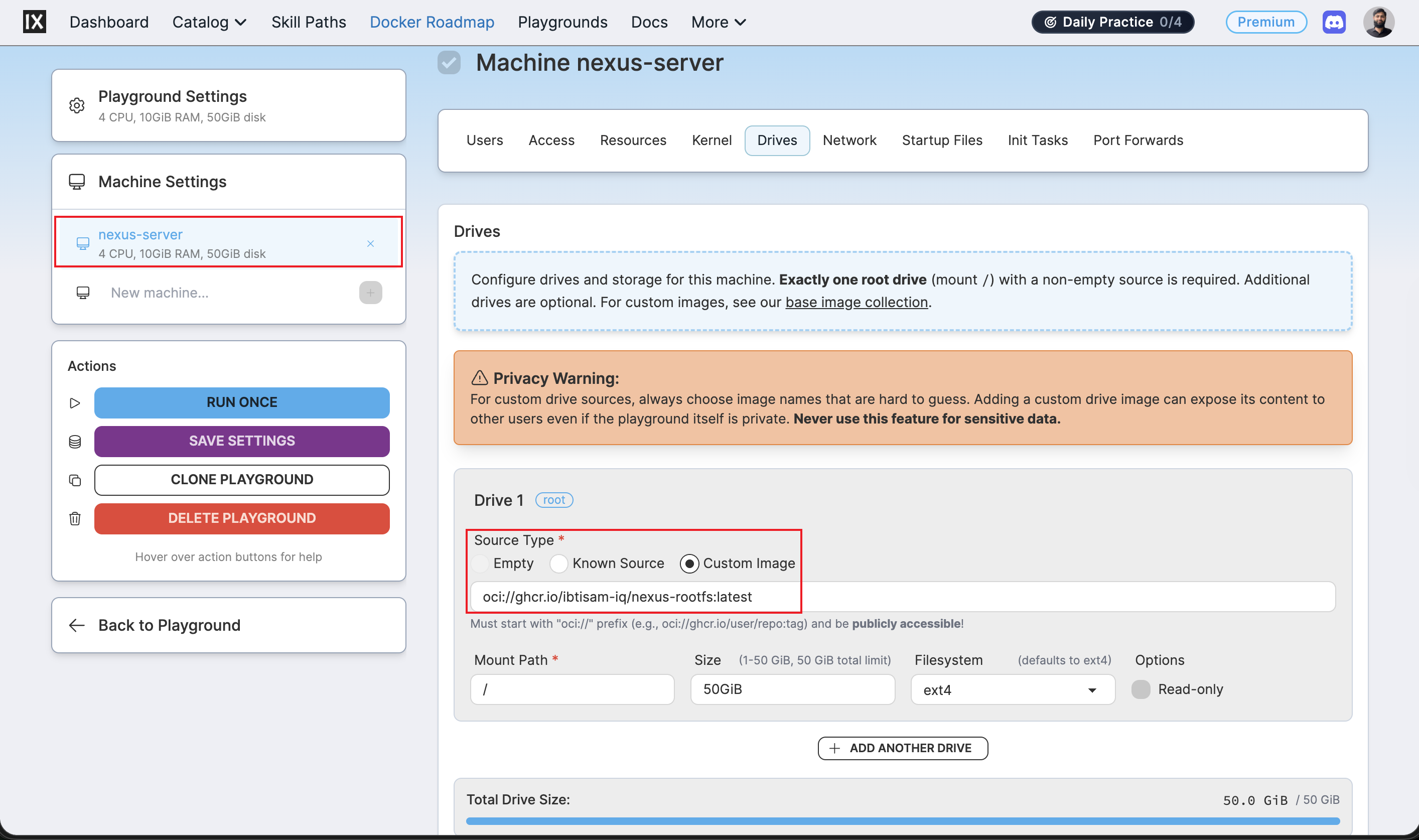
The manifest declares a single machine nexus-server whose root drive is mounted directly from the published GHCR image:
The manifest can be edited before running: for example, to adjust cpuCount, ramSize, or size to match account quota or preferences.
Run labctl playground create pointing at the local manifest:
When the command succeeds, labctl prints the playground URL and its unique ID:
Creating playground from /Users/ibtisam-iq/gitHub/silver-stack/iximiuz/manifests/nexus-server.yml
Playground URL: https://labs.iximiuz.com/playgrounds/SilverStack-nexus-server-9a3f87e9
SilverStack-nexus-server-9a3f87e9
Note
The playground does not appear under Playgrounds → Running. Custom playgrounds created via labctl appear under Playgrounds → My Custom.
Step 2: Open the playground
Click the URL printed by labctl, or navigate manually:
- Open labs.iximiuz.com/dashboard.
- In the dashboard navigation bar, click Playgrounds.
- Under Playgrounds, click the My Custom tab.
- Locate the playground by the
titleset in the manifest file (e.g.,SilverStack Nexus Server). If the manifest title was customized before running, look for that name instead. - The playground card shows a Start button and a three-dot menu (⋮).
To start immediately, click Start.
To review or adjust settings before starting, click ⋮ → Configure. This opens the Playground Settings page where machine drives, resources, network, and UI tabs can be inspected before launch.
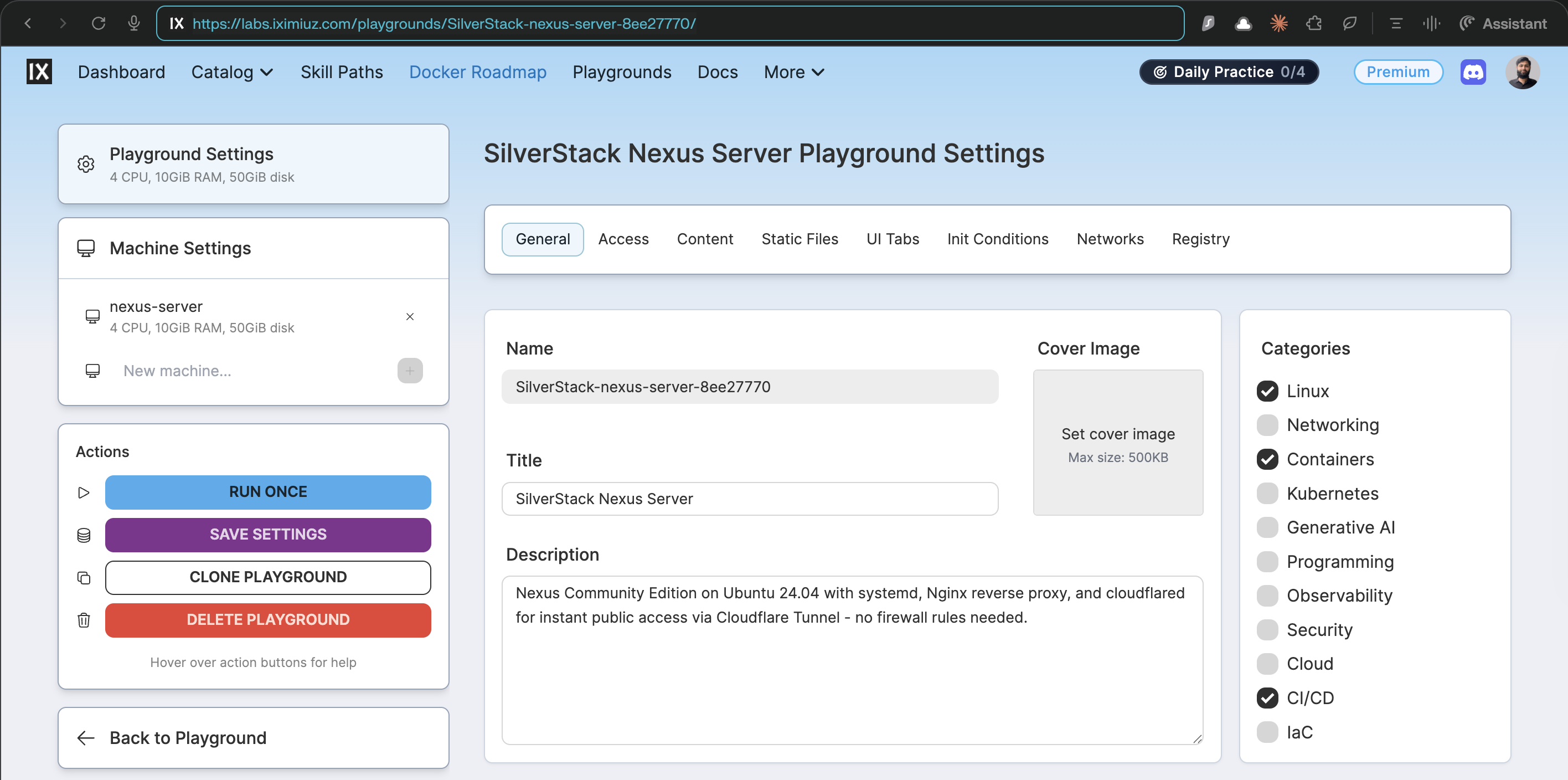
Step 3: Verify the running playground
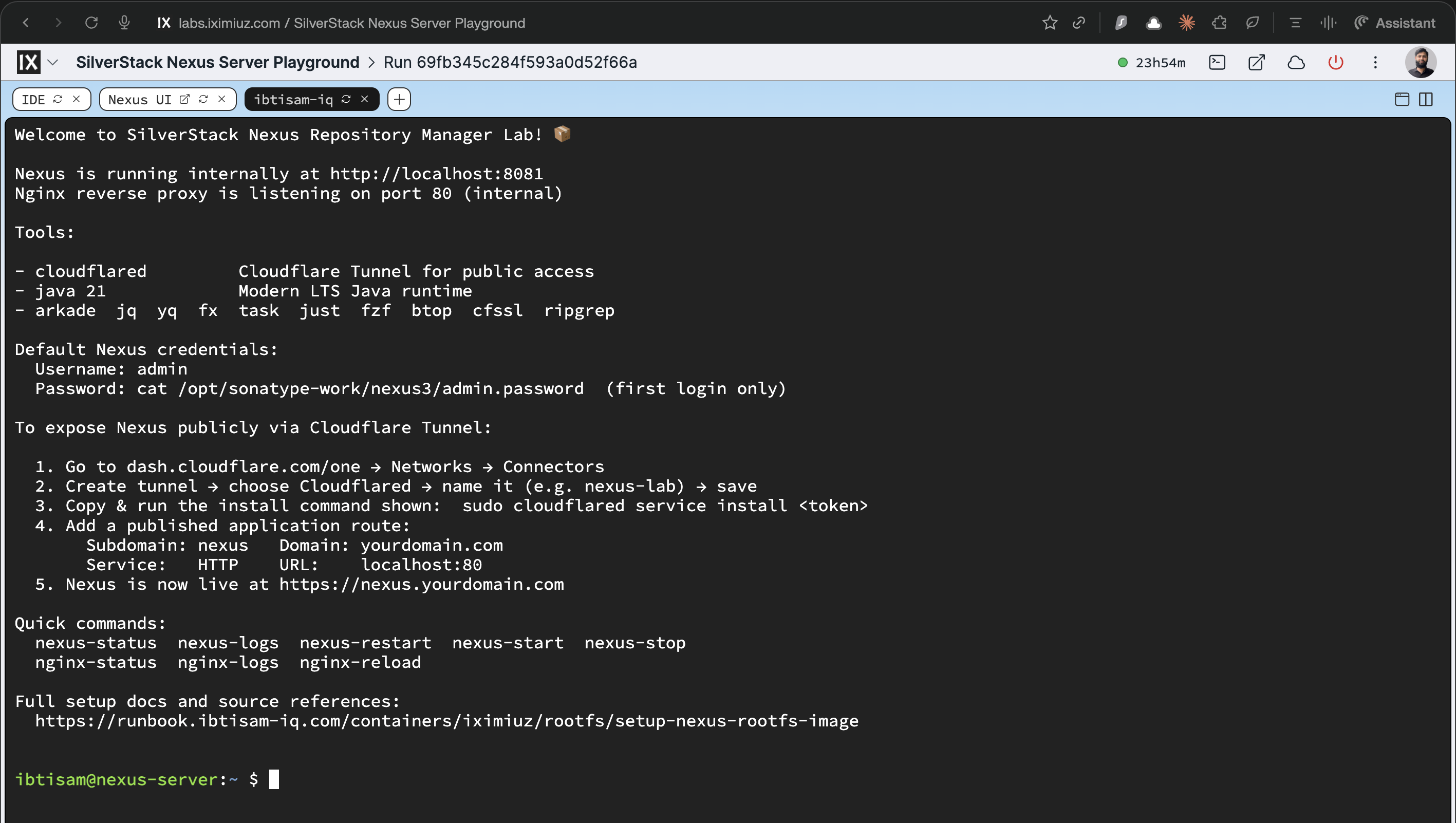
Once started, the welcome banner is displayed automatically and shows the configured internal ports, service status commands, and next steps.
Follow the instructions in the welcome file for post-setup tasks.
Cloudflare Tunnel Configuration
To expose the service on a custom public domain, cloudflared is already installed in the image. The welcome page includes step-by-step instructions for configuring and connecting the tunnel. Follow those instructions on first login.
If any issues arise during Cloudflare Tunnel setup, refer to phase 4 in the following runbook:
Related Reading
📖 self-hosted-cicd-stack-journey-from-ec2-to-iximiuz-labs.md